


Energy management has changed drastically over the last decade. Facilities no longer rely on monthly utility bills to track energy use. Monthly bills only show past consumption. They do not show when or where waste occurs.
Today, modern facilities require immediate insights into their power consumption. High energy costs and strict environmental rules force companies to adapt. Organizations must monitor their electrical loads in real time to reduce costs.
Submetering plays a vital role in this change. Traditional metering measures the total energy of an entire building. Submetering goes deeper. It energy use at specific departments, floors, measures, or heavy machines.
However, collecting data from individual submeters presents a major challenge. Legacy submeters use older serial communication methods. Modern corporate networks use Internet Protocol (IP) networks. This article explains how connectivity devices bridge this communication gap to enable real-time energy analytics.
The Legacy Challenge in Submetering
Many existing facilities use traditional digital power meters. Manufacturers build these meters with serial communication ports. The most common serial standard in the energy industry is RS-485.
1. Why Engineers Used RS-485
Engineers chose RS-485 for specific reasons:
-
It supports long cable runs up to 1,200 meters.
-
It resists electrical noise in busy industrial environments.
-
It allows daisy-chaining of multiple meters on one twisted-pair wire.
2. The Limits of Serial Communication
RS-485 has severe limitations in the modern digital age. Serial networks operate at slow speeds. They cannot transmit large amounts of data quickly.
Furthermore, you cannot plug an RS-485 cable directly into a modern computer network. Local servers and cloud platforms require Ethernet or Wi-Fi connections. Without a way to bridge this gap, energy data remains trapped inside the meters. Staff must manually read meter screens, which wastes time and causes errors.
Connecting Serial Meters to Modern Networks
To solve this connectivity problem, facility managers use hardware communication bridges. This device connects the physical RS-485 serial bus to a standard Local Area Network (LAN).
Industry professionals use two common terms for this technology:
-
RS-485 to Ethernet Converter
-
RS-485 to Lan Converter
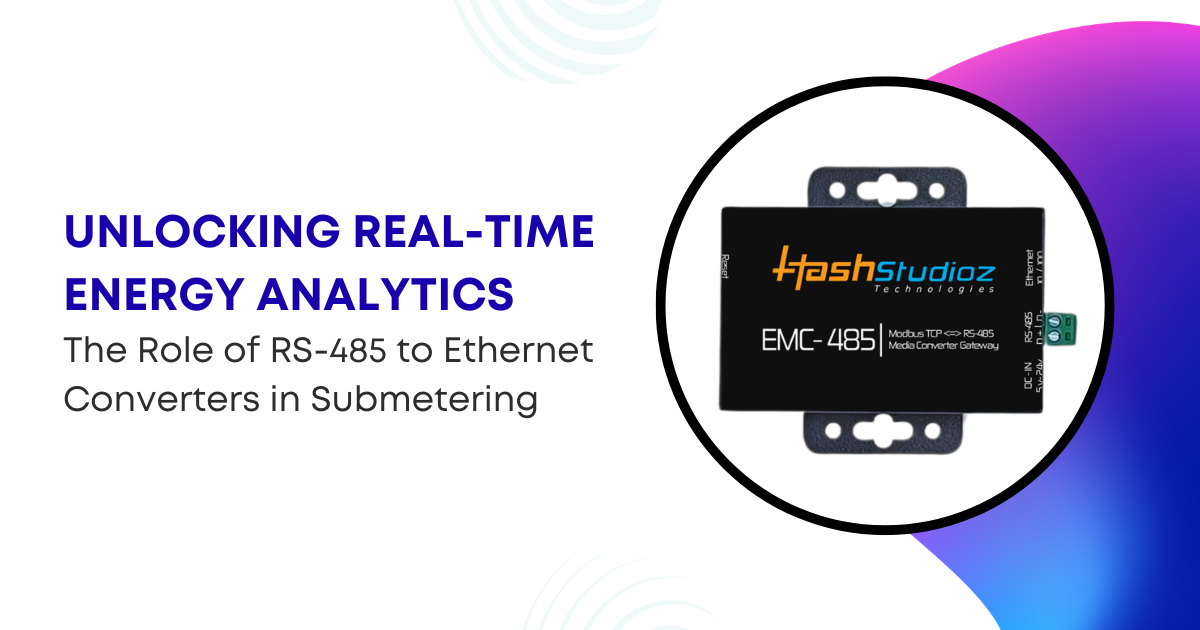
These devices act as translators. The converter receives serial data from the power meter. It packages this data into standard network packets. Then, it sends the packets over standard network cables to local servers or cloud databases.
This process also works in reverse. Software on the network can send commands back to the meters. This two-way communication allows for total remote control of the metering network.
Technical Mechanics of the Hardware Bridge
An RS-485 to Ethernet Converter handles complex tasks inside its compact enclosure. Understanding these internal functions helps engineers choose the right device for their facility.
1. Protocol Conversion
Most RS-485 power meters use the Modbus RTU protocol. This protocol is a simple serial communication language. On the other side, modern energy management software uses Modbus TCP. Modbus TCP is the network-based version of the same language.
The RS-485 to Lan Converter performs protocol conversion. It strips away the serial framing from the Modbus RTU data. It then wraps the raw energy data into a standard TCP/IP packet. This conversion happens in milliseconds.
2. Data Buffering and Speed Matching
Serial networks operate at slow speeds, often around 9,600 bits per second. Ethernet networks operate at much higher speeds, typically 100 million bits per second or more.
The converter includes internal memory chips. This memory stores data temporarily during the transfer process. The device matches the slow serial speed with the fast network speed without losing vital energy data.
Key Benefits for Industrial and Commercial Facilities
Installing an RS-485 to Ethernet Converter provides instant advantages to facility operators. It turns isolated meters into an active data network.
1. Immediate Visibility
Users no longer wait for the end of the month to see energy spikes. The converter transmits data continuously. Software dashboards show power consumption as it happens. Operators can spot abnormal energy use instantly.
2. Lower Installation Costs
Rewiring a whole building with new native Ethernet meters costs thousands of dollars. It requires new hardware and extensive labor.
Using an RS-485 to Lan Converter saves money. You keep your existing, working RS-485 submeters. You only buy one converter for each daisy chain of meters. This approach lowers upgrade costs significantly.
3. Centralized Data Management
Large industrial plants have meters spread across many buildings. Connecting every chain to a local network brings all data to one central station. Managers can monitor multiple buildings from a single desk.
Real-Time Energy Analytics in Action
Data collection is only the first step. The true value comes from analyzing the data to make smart business decisions.
1. Demand Charge Management
Electric utilities charge commercial customers based on peak usage periods. These penalties are called demand charges.
Real-time tracking allows companies to monitor their peak load thresholds. If energy use approaches a dangerous limit, the system alerts managers. Workers can shut down non-essential equipment to keep costs down.
2. Predictive Machine Maintenance
Healthy machines use a predictable amount of power. When components like bearings or motors begin to fail, mechanical friction increases. This friction forces the machine to draw more electricity.
Analytical software detects these tiny increases over time. Maintenance teams receive alerts to inspect the machine before a costly breakdown occurs.
Industry Statistics and Financial Impact
Data from global energy studies confirms the value of submetering networks. Companies reduce costs fast when they gain clear visibility into their consumption.
| Metrics and Impact Categories | Verified Statistical Data |
| Average energy bill reduction from submetering | 5% to 15% annually |
| Operational cost reduction via automated data collection | Up to 12% |
| Proportion of energy waste in unmonitored commercial buildings | 30% on average |
| Typical payback period for serial-to-ethernet hardware | Less than 6 months |
These numbers show that connectivity hardware pays for itself quickly. Saving even 10% on a large industrial power bill saves thousands of dollars every month.
Choosing the Right Converter
Not all communication adapters offer the same performance. Engineers must evaluate several hardware features before purchasing a device for their submetering project.
1. Isolation and Protection
Industrial environments contain heavy electrical equipment. High-power machines create voltage spikes and electromagnetic interference.
Ensure your converter features optical isolation and surge protection on the serial ports. This protection prevents high voltage from destroying your network gear.
2. Port Density
Calculate the number of separate serial lines in your facility. Small systems only need a single-port converter. Large factories might require devices with two, four, or eight serial ports to handle multiple meter chains simultaneously.
3. Operating Temperature Range
Meters often sit inside metal electrical cabinets outdoors or in unconditioned factory areas. Standard commercial IT gear fails in extreme heat or cold. Choose industrial-grade converters that operate reliably between -40°C and 85°C.
Step-by-Step Implementation Guide
Deploying an RS-485 to Ethernet Converter requires a clear, methodical approach. Follow these basic steps for a successful installation.
1. Wire the Serial Side
Connect the submeters together using a shielded twisted-pair cable. Wire the positive terminal to positive, and negative to negative. Connect the final meter in the chain to the serial port of your converter.
2. Connect to the Network
Plug a standard Ethernet cable into the RJ45 port of the converter. Connect the other end of the cable to an active network switch or router on your facility's LAN.
3. Configure the Network Settings
Open a web browser on a local computer. Type the default IP address of the converter into the address bar. Set a permanent, static IP address for the device so the software can always find it.
4. Set Up Serial Parameters
Match the serial settings in the converter to the settings on your meters. You must set identical values for three main parameters:
-
Baud rate (e.g., 9600 bps)
-
Data bits (e.g., 8)
-
Parity (e.g., None)
5. Link Your Analytics Software
Open your energy management software platform. Add the static IP address of your converter as a new device data source. Input the specific Modbus IDs for each connected meter to start the live data stream.
Common Installation Pitfalls to Avoid
Simple installation mistakes can cause data corruption or communication loss. Watch out for these common errors during setup.
1. Wrong Termination Resistors
Long RS-485 lines require a 120-ohm resistor at the very end of the cable run. This resistor stops electrical signal reflections. Leaving this resistor out causes mysterious data drops. Adding too many resistors overloads the signal entirely.
2. Incorrect Grounding Practices
Serial cables need proper grounding to shield against electrical noise. Always ground the cable shield at one single point. Grounding the shield at multiple points creates ground loops, which corrupt your data.
3. Overloading the Serial Chain
The RS-485 standard accommodates up to 32 standard devices on a single segment. Adding too many meters slows down communication speeds. It can also weaken the electrical signal below readable levels.
Future Trends in Facility Energy Analytics
The field of energy management continues to evolve rapidly. The demand for fast, reliable data grows stronger every year.
1. Edge Computing Integration
Newer communication adapters do more than just pass data along. They feature built-in microprocessors to analyze data right at the source.
These smart converters filter out minor noise and summarize usage logs. They only transmit critical data changes across the main network. This reduction in traffic preserves valuable network bandwidth.
2. Software as a Service Platforms
More companies now host their analytics software in the cloud. Modern converters connect directly to cloud servers using secure internet protocols. This setup lets managers check energy data on mobile phones from anywhere in the world.
Understanding Network Architecture
To get the most out of your monitoring network, you must understand the layout. Data flows from the physical meter through the converter to the main system.
The converter handles packets carefully. It assigns a unique identifier to each submeter. This method ensures that the software correctly matches incoming numbers with the right machine.
1. Scalability Factors
As your business expands, your monitoring system must grow too. A network based on internet protocols scales up easily. You can add more converters to the network without disrupting the existing meters.
This flexibility makes it simple to add whole new departments to your tracking software. You do not need to run miles of copper wire back to a central office. Instead, you just tap into the nearest network switch.
Enhancing Data Security
Security is a major priority when connecting factory hardware to corporate IT networks. Industrial serial protocols like Modbus RTU reduced safety features when engineers first built them. They did not include encryption or passwords.
1. Modern Security Protocols
An advanced RS-485 to Ethernet Converter solves this security issue. Many modern devices support secure network features like HTTPS for configuration and IP address filtering.
These features block unauthorized users from accessing the serial chain. You can configure the converter to accept connections only from the specific server running your energy software. This step keeps your factory floor data safe from outside interference.
Long-Term Maintenance and Reliability
Once your submetering network runs smoothly, it requires very little daily attention. However, regular maintenance keeps the system highly accurate over time.
1. Firmware Updates
Hardware manufacturers release software updates for their converters periodically. These updates patch security holes and improve data processing speeds.
Check the manufacturer website twice a year for updates. Applying these updates ensures your system remains compatible with new IT standards.
2. Physical Inspections
Industrial environments subject hardware to vibrations and dust. Inspect your electrical cabinets every six months.
Check that the RS-485 terminal screws remain tight. Loose wires cause intermittent data loss that can skew your weekly energy reports. Also, verify that network cables remain securely clicked into their ports.
Surgery
Real-time energy tracking is no longer a luxury for modern business operations. It is a necessary tool to control operational costs and reduce waste.
Legacy submeters provide highly accurate data but lack modern connectivity features. The RS-485 to Ethernet Converter bridges this gap simply and affordably.
Using an RS-485 to Lan Converter protects your existing equipment investments. It opens up immediate access to deep energy analytics. These small devices help companies transform raw electricity data into actionable financial savings.

 English
 Arabic
 French
 Portuguese
 Deutsch
 Turkish
 Dutch
Dutch
 Italiano
 Russian
 Romaian
 Portuguese (Brazil)
 Tiếng Việt