


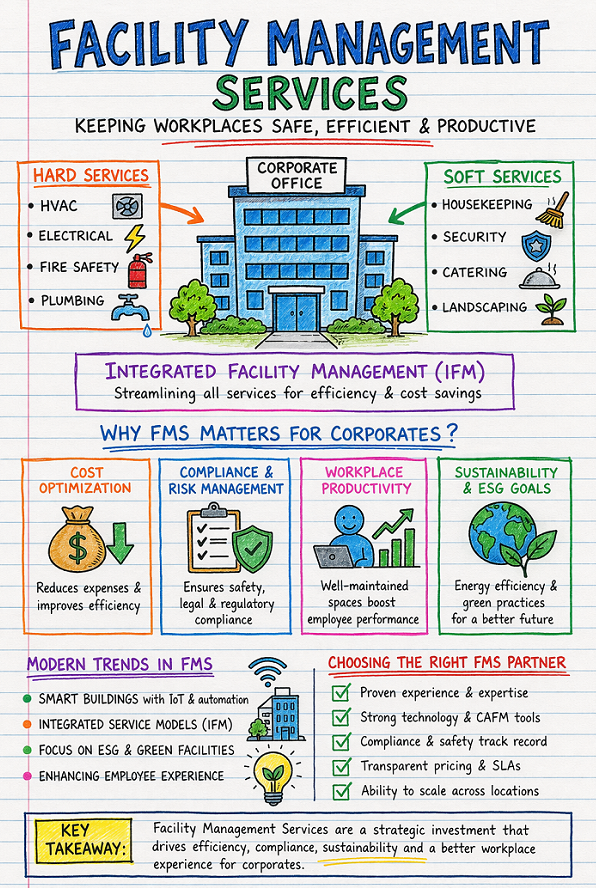
Facility Management (FM) is a professional discipline focused on the efficient and effective delivery of support services for the organizations that it serves. It encompasses multiple disciplines to ensure the functionality, comfort, safety, and efficiency of the built environment by integrating people, place, process, and technology. The expansive Facility Management Services industry is the engine that keeps commercial, industrial, and institutional buildings running, enabling businesses to focus on their core objectives. The scope of this industry is vast, covering everything from the physical fabric of a building, known as "hard services," to the services that support the people within it, known as "soft services." At its core, the industry's mission is to coordinate and oversee the safe, secure, and environmentally-sound operations and maintenance of these assets in a cost-effective manner. As buildings become more complex and business needs more dynamic, the role of the facility management professional has evolved from a tactical building manager to a strategic partner who directly influences business productivity, employee well-being, and corporate sustainability goals, making it an indispensable part of the modern economy.
The industry is broadly categorized into two primary service lines: hard services and soft services. Hard Facility Management services are those that relate directly to the physical structure and essential systems of the building. These services are often required by law to ensure the safety and well-being of occupants and cannot be removed or ignored. The portfolio of hard services includes the maintenance of heating, ventilation, and air conditioning (HVAC) systems, which are critical for air quality and thermal comfort. It also encompasses the management of all electrical systems, from lighting to power distribution; plumbing and water systems; and fire safety systems, including alarms and sprinklers. Furthermore, hard FM involves the structural maintenance of the building itself, covering the roof, walls, and foundations. The delivery of these services requires skilled and certified technicians and is increasingly being transformed by technology, such as Building Information Modeling (BIM) and predictive maintenance sensors, to move from a reactive "fix-on-fail" model to a proactive, data-driven approach that prevents system failures and extends asset lifecycles.
In contrast, soft Facility Management services are those that enhance the workplace environment, making it a more pleasant, secure, and productive place for people to work. While not always physically integrated into the building, these services are crucial for the day-to-day operations and the overall employee experience. The most common soft service is cleaning and janitorial services, which are fundamental to maintaining a healthy and hygienic environment, a factor that has gained immense importance in recent years. Security services, including manned guarding, access control systems, and CCTV monitoring, are vital for protecting the organization's people and assets. Other essential soft services include catering and vending, waste management and recycling programs, landscaping and groundskeeping, and mailroom and reception services. The quality of these services has a direct and tangible impact on employee satisfaction, morale, and productivity. As companies compete for top talent, providing a superior workplace experience through high-quality soft services has become a key strategic differentiator.
The evolution of the facility management industry has been marked by a significant shift from a fragmented, cost-focused function to a consolidated, strategic business partner. In the past, companies would manage dozens of individual contracts for each specific service. The modern approach, known as Integrated Facility Management (IFM), involves outsourcing a full suite of hard and soft services to a single, strategic provider. This integrated model delivers significant benefits, including cost savings through economies of scale, streamlined communication and accountability through a single point of contact, and standardized service quality across an entire real estate portfolio. More importantly, IFM elevates the role of facility management to a strategic level. A sophisticated IFM partner can provide valuable data and insights on space utilization, energy consumption, and asset performance, helping the client make informed real estate decisions. They play a critical role in helping organizations achieve their Environmental, Social, and Governance (ESG) targets and are central to designing and implementing workplace strategies that support new ways of working, such as hybrid models, solidifying FM's position as a driver of business value.
Explore Our Latest Trending Reports!
Art Painting Wall Decoration Market
Artificial Intelligence In Banking Market

 English
 Arabic
 French
 Spanish
 Portuguese
 Deutsch
 Turkish
 Italiano
 Russian
 Romaian
 Portuguese (Brazil)
 Tiếng Việt