


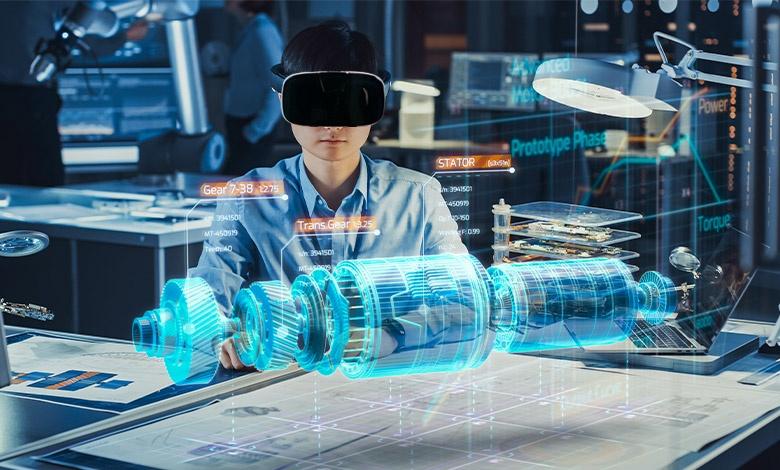
To successfully leverage augmented reality in a factory setting, a company needs more than just a set of smart glasses; it needs a robust and scalable software platform. A comprehensive Augmented Reality In Manufacturing Market Platform is the digital backbone that enables the creation, management, delivery, and analysis of AR experiences across an enterprise. This integrated solution typically consists of three primary layers. The first is a content authoring or creation environment, where digital work instructions and AR experiences are built. The second is a central management console, which acts as the command center for deploying content, managing users and devices, and integrating with other business systems. The final layer is the runtime client application, the software that runs on the end-user's device (such as a smartphone, tablet, or smart glasses) and renders the AR experience in the real world. The core purpose of such a platform is to abstract away the underlying technical complexity of AR, making the technology accessible and manageable. It empowers the people who know the manufacturing processes best—the engineers, technicians, and training managers—to digitize their knowledge and deploy it to the frontline workforce, a crucial capability for achieving scale.
The content authoring component is arguably the most critical part of the platform, as the value of AR is entirely dependent on the quality and availability of relevant content. Modern AR platforms have moved away from requiring specialized programming skills and now offer intuitive, often web-based, authoring studios with user-friendly, drag-and-drop interfaces. Within this environment, an author can import 3D CAD models of products and machinery directly from their PLM system. They can then create step-by-step procedures, attaching text instructions, images, and instructional videos to each step. Most importantly, they can add 3D visual cues—such as arrows, circles, and animated sequences—that will appear as holograms in the real world, guiding the worker's actions with precision. This process of creating a rich, interactive digital work instruction is designed to be as simple as building a PowerPoint presentation. This democratization of content creation is a game-changer. It eliminates the "content bottleneck" that plagued early AR projects and allows a company to rapidly build a large library of AR-guided workflows, ensuring that the digital content is always accurate, up-to-date, and perfectly aligned with the real-world tasks on the factory floor.
A standalone AR experience has limited value in a connected factory. The true power of an AR platform is unlocked through its integration and management capabilities. The platform's central management console serves as the bridge between the AR experiences and the company's core enterprise systems. Through APIs and pre-built connectors, the platform can pull information from and push information back to systems like the Manufacturing Execution System (MES) to access real-time production orders, the Enterprise Resource Planning (ERP) system to verify part numbers and inventory levels, and the Product Lifecycle Management (PLM) system to ensure the latest 3D CAD designs are being used. This integration enables dynamic, data-driven workflows. The management console also handles user and device management, allowing administrators to assign specific work instructions to different teams or individuals. Critically, it also collects a wealth of data during task execution. It can track how long each step takes, log which steps cause the most errors, and capture photographic evidence for audit trails. This transforms AR from a simple guidance tool into a powerful data collection engine, providing managers with unprecedented insights into manual processes and enabling continuous improvement.
The final piece of the platform is the runtime client application, which is the software the frontline worker interacts with on their chosen device. A robust platform must provide a high-performance, stable client that is optimized for a wide array of hardware. This includes commercially available smartphones and tablets, which are often used for mobile inspection and maintenance tasks, as well as the full spectrum of head-worn devices. These range from monocular "assisted reality" devices like the RealWear Navigator, which display a 2D screen in the user's peripheral vision for hands-free information access, to fully immersive binocular "mixed reality" smart glasses like the Microsoft HoloLens 2, which can place stable, interactive 3D holograms in the user's environment. The client application is responsible for advanced technical functions like spatial tracking (understanding where the device is in the room), object recognition (identifying a specific machine or part), and rendering complex 3D graphics accurately and without lag. Providing a flexible, hardware-agnostic platform is a key differentiator, as it allows a manufacturing company to select the best possible device for each specific job, ensuring optimal usability, safety, and performance across the diverse range of tasks on a factory floor.
Top Trending Reports:

 English
 Arabic
 French
 Spanish
 Portuguese
 Deutsch
 Turkish
 Dutch
Dutch
 Italiano
 Russian
 Romaian
 Portuguese (Brazil)