


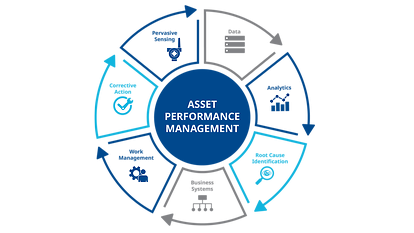
The competitive landscape and distribution of the Asset Performance Management Market Share are defined by a fascinating convergence of two distinct types of industry titans: established industrial giants with deep domain expertise and powerful enterprise software specialists. The market is not dominated by a single entity but is instead a competitive arena where these players leverage their unique strengths to capture a piece of the rapidly growing pie. Market share is often determined by a company's ability to offer a comprehensive, end-to-end platform, the strength of its analytics and AI capabilities, its industry-specific knowledge, and the size of its existing customer base in adjacent markets like enterprise asset management (EAM) or industrial automation.
A significant portion of the market share is held by major industrial conglomerates such as GE Digital, Siemens, Honeywell, and Schneider Electric. These companies have a distinct advantage because of their centuries-long history of manufacturing and operating the very physical assets that APM solutions are designed to manage. They possess an unparalleled depth of domain knowledge—they understand how a gas turbine, a robotic arm, or an electrical grid is supposed to behave. This allows them to build highly accurate physics-based models and analytics that are tailored to specific equipment. Companies like GE, with its Predix platform, and Siemens, with MindSphere, are leveraging this industrial heritage to position themselves as holistic partners for digital transformation, offering a combined package of hardware, software, and deep engineering expertise.
On the other side of the competitive spectrum are the powerful enterprise software and analytics companies, including AVEVA, AspenTech, IBM, SAP, and Oracle. These firms approach the market from a position of strength in data management, enterprise-scale software architecture, and advanced analytics. Their advantage lies in their ability to integrate APM functionalities with broader enterprise systems like Enterprise Resource Planning (ERP) and Enterprise Asset Management (EAM), providing a single, unified view of operations and finance. IBM's Maximo Application Suite and AVEVA's comprehensive portfolio (strengthened by its acquisition of OSIsoft) are prime examples of this software-centric approach, offering robust platforms that can manage data from a wide variety of assets and sources, regardless of the original equipment manufacturer.
The battle for market share is increasingly being fought through strategic partnerships and ecosystem development. No single company can provide every piece of the APM puzzle, so building a strong network of partners is a critical strategy. This involves collaborations between industrial giants and software specialists, as well as partnerships with cloud providers (like AWS and Azure), systems integrators, and specialized analytics startups. The dominant trend is the move towards open platforms that allow third-party developers to build applications on top of them, fostering a rich ecosystem of innovation. The companies that are most successful in creating these open, collaborative ecosystems, rather than closed, proprietary systems, are best positioned to capture and expand their market share in the long run.
Explore More Like This in Our Regional Reports:

 English
 Arabic
 French
 Spanish
 Portuguese
 Deutsch
 Turkish
 Dutch
Dutch
 Italiano
 Russian
 Romaian
 Portuguese (Brazil)